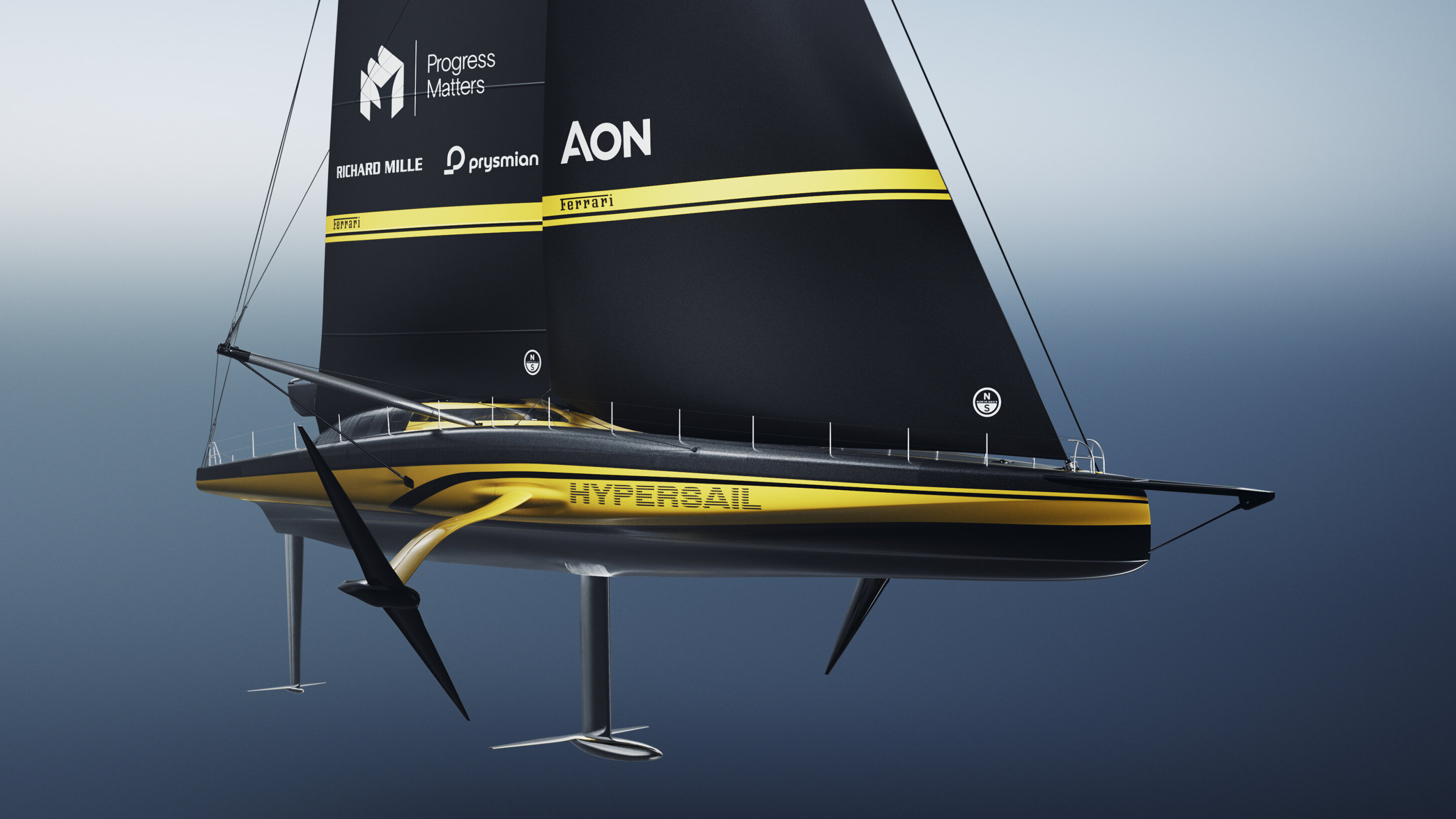
It won't be red. It'll be a Ferrari in deep dark gray and Giallo Fly. A betrayal? Maybe not, just an attempt to step away from a color that has become a logo, one the public expects in a very precise shade, according to an age-old ritual. That's the aesthetic novelty of Ferrari Hypersail: the livery seems designed specifically so the logo can be read from a distance. Few combinations, after all, are more visible than yellow text on a black or near-black background, a pairing made necessary by the extensive solar panel coverage on the hull and by carbon fiber's characteristic color. But we know the real innovations are inside the boat. This is a project revealing the full extent of its complexity and research.
The boat, a thirty-meter monohull, "is literally terrifying," setting aside all the nice talk about cross-pollination and technology transfer, it will be the sum of every contemporary experience tied to super-fast sailing, starting with foiling, moving through onboard energy production, and ending with the sophisticated control and simulation systems needed to sail it. There's a body of "literature" built up both in the sailing world, especially the America's Cup, which uses similar monohulls, and in the automotive world and Formula 1, where simulation and software play a major role. The bet here is to evolve those systems and create dedicated, proprietary ones. We're still in a highly experimental phase; something changes every day. After an America's Cup race, teams always update their software to reflect the day's experience, adjusting sail trim and foil settings. Now, a Cup race lasts about 25 minutes. Imagine an ocean crossing, which is this boat's ambition, nonstop for four days, or a round-the-world voyage in 40 days: everything is different. Onboard there will be two Ferrari Luce motors. Energy is produced by solar panels, wind generators, and also by the human crew, through a winch-by-wire system that generates power without the crew feeling the load of the sails, but under optimal conditions for whoever is working the grinder. For records to be valid, sail trim and everything that happens on deck must be done using human power, while other adjustments, like the foils, can be handled by assisted systems. The movement of the appendages needed to guarantee active flight control is managed using energy recovered from renewable sources, with high-voltage batteries installed to regulate the dynamics of the energy flows.
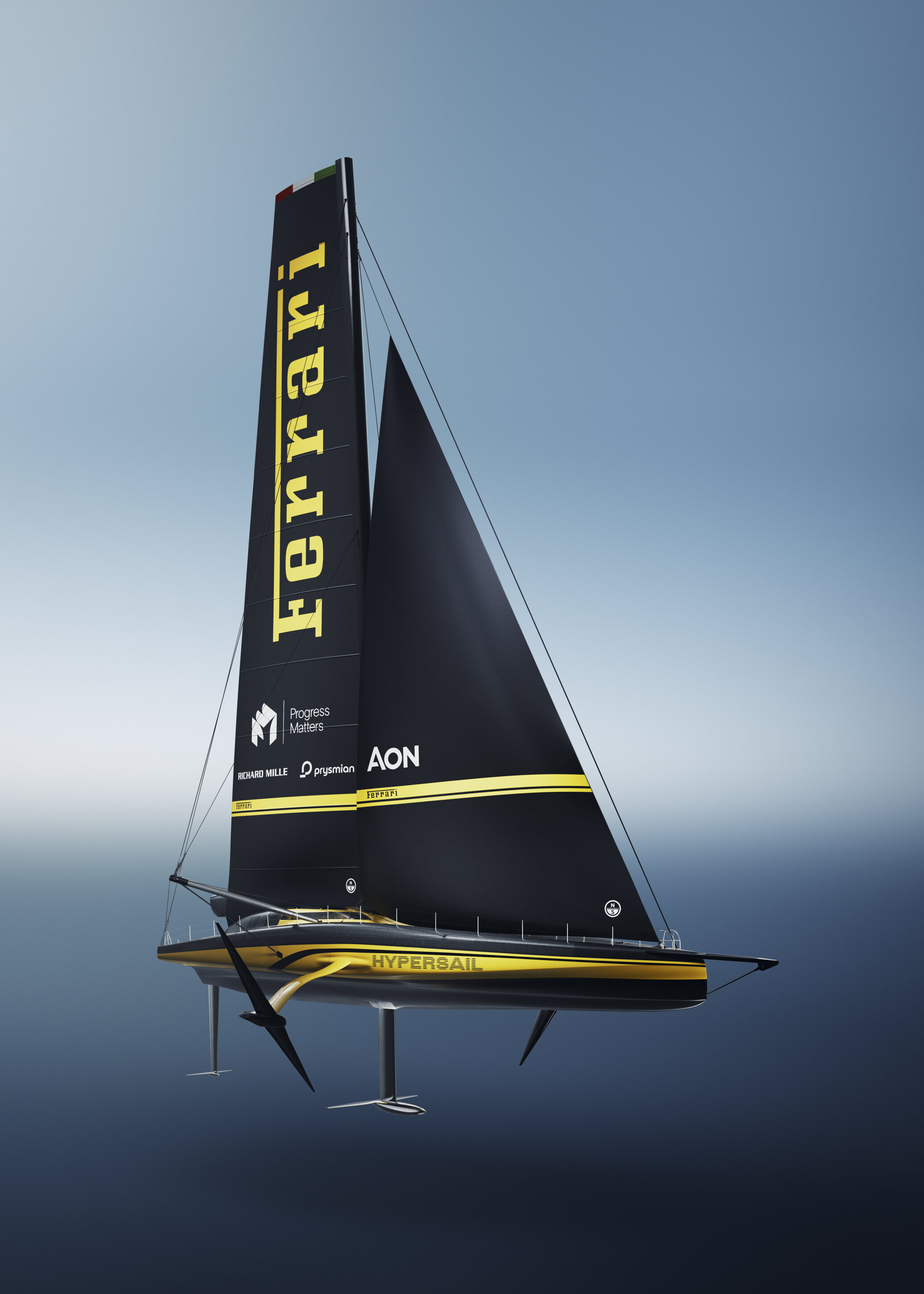
On Hypersail, design is oriented entirely toward performance and is never merely an aesthetic matter, it's a direct consequence of function: every volume is born from the interaction between wind, water, and speed. Since this is an offshore ocean-going boat, the aesthetic choices, from day one, developed within tight boundaries set by aerodynamics and engineering. Ferrari Design Studio, led by Flavio Manzoni, worked in close collaboration with designer Guillaume Verdier and Ferrari's team of engineers to translate aerodynamic, hydrodynamic, and structural constraints into aesthetic opportunities. The tapered silhouette recalls the lines of the Ferrari Monza SP1/SP2, while the exterior of the coachroof on deck echoes the architecture of the 499P Hypercar, winner at Le Mans.
Flavio Manzoni, Ferrari's Chief Design Officer, says: "Hypersail represented an unexpected opportunity for Ferrari Design Studio, a challenging goal, given its complexity, that allowed us to extend our creative research into a context different from our usual one." The solar panels are a telling example, integrated into the deck and the bulwarks. Their placement was determined by a study of the sun exposure Hypersail will experience while sailing. The solar panels are walkable and fitted with specific grip.
"Hypersail is a boat unique in both size and technology, developed to guarantee maximum performance in an environment as unique and unpredictable as the ocean. This is thanks to the underlying concept: flight, made possible through a sophisticated control system, the product of know-how built up on our cars, powered by energy recovered from renewable sources like wind, sun, and motion," explains Matteo Lanzavecchia, Head of Vehicle Engineering at Ferrari and Chief Technology Officer for Hypersail. "The decision to design a monohull comes from the combination of maximum hydrodynamic and aerodynamic efficiency."
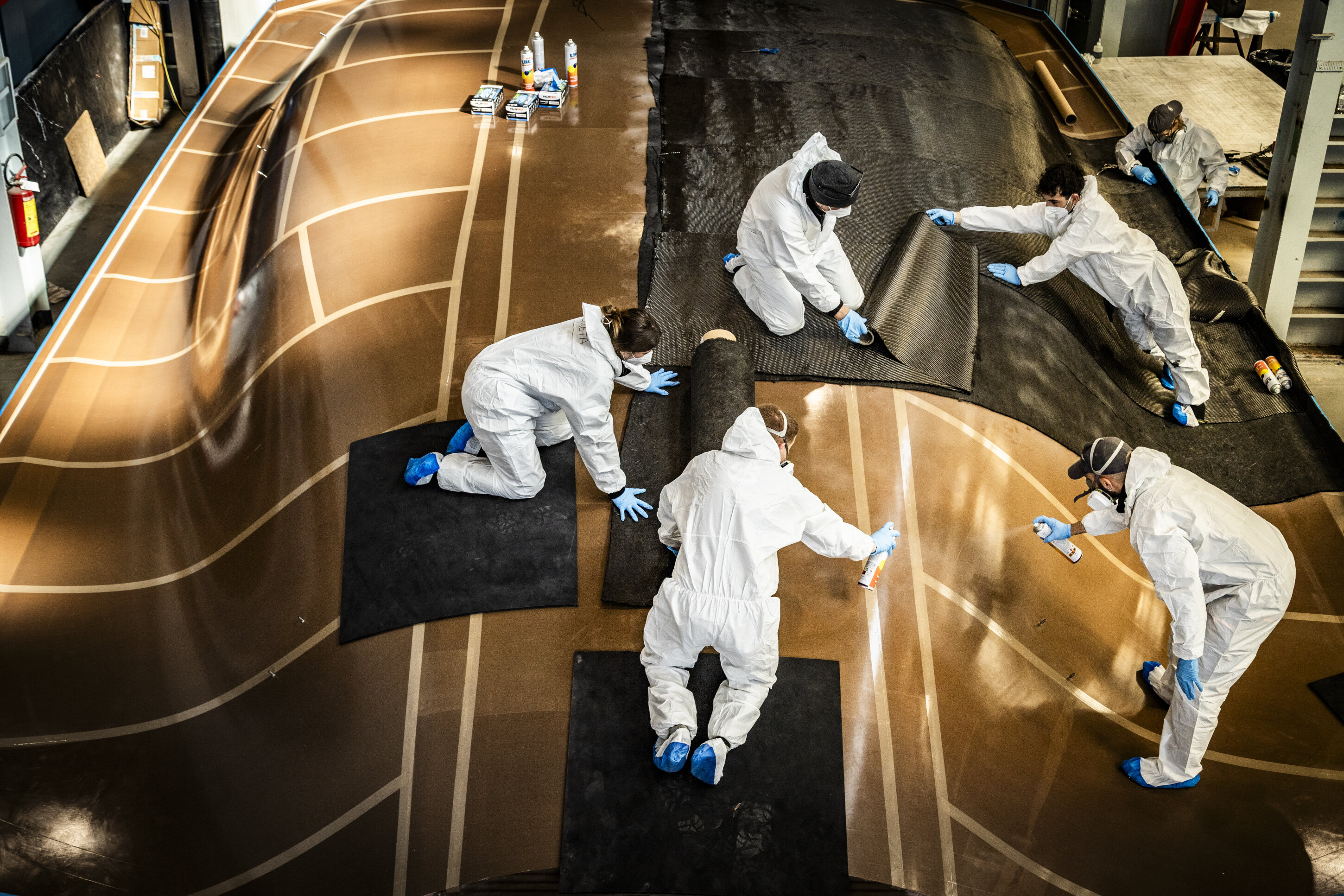
The main material used in Hypersail is carbon fiber: a shade of gray, in a new variant renamed Grigio Hypersail, dominates the livery. The contrast between this gray and the iconic Giallo Fly creates an aesthetic that recalls the 512 BB, the first example of an integrated livery.
Enrico Voltolini explains: "Now we have to work on everything related to reliability, which hasn't been addressed yet at this stage. We're going out on the water with systems that are currently used in racing, but we're not sure they can perform for the length of time needed to complete a round-the-world voyage. Unfortunately, that's something we'll only discover by sailing or by testing. The boat will have a kind of remote garage, with live data transmitted from the boat via satellite antennas to our offices. The boat will be monitored by a team of engineers tracking performance, as well as by meteorology experts and other specialists in navigation. In the Mediterranean we'll be able to follow it with a support boat, but after that, it won't be possible anymore."
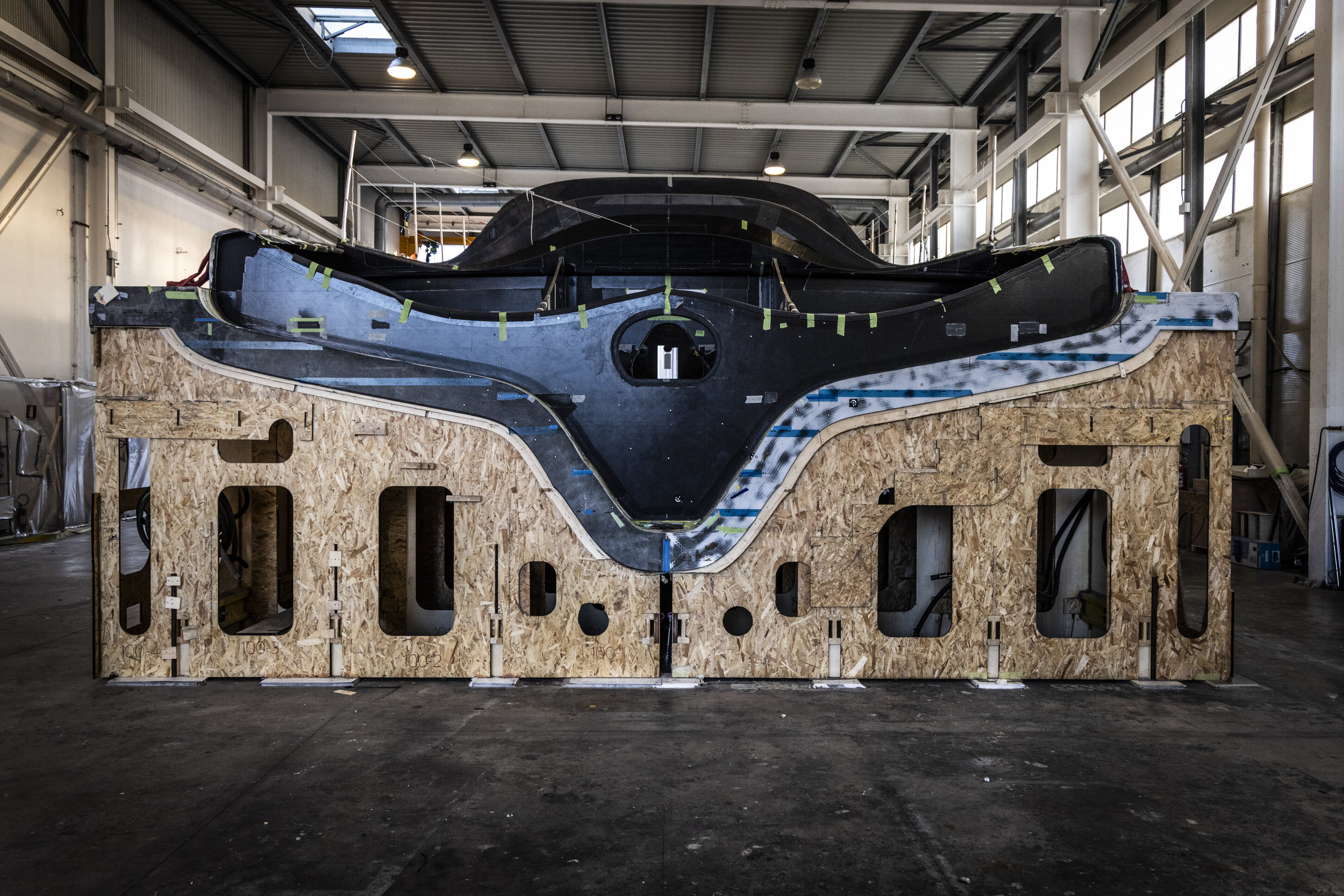
One of the key tools for the Hypersail project is a powerful simulator, capable, in practice, of simulating "everything", both the sailing itself and, above all, energy consumption and its management. Matteo Lanzavecchia explains: "Having that tool lets us run a whole series of tests well in advance, tests that have a real impact on decisions in the design process. Once we've gathered the experience, we go back, like salmon swimming upstream, to redesign things, refining ergonomics and the sailors' controls. There are also three other important test benches: one that simulates all of the onboard electronics, which has been running for two and a half years with all the electronics we'll be installing in the boat tomorrow. We have solar panels mounted on a roof rig to analyze the various energy flows and fine-tune the software and hardware. We run cross-tests simulating errors that could occur. In short, we're evaluating the entire system before we ever go out on the water."
Marco Guglielmo Ribigini, Ferrari's Technical Team Leader, concludes: "This is a complex project,it's a bit like going to the Moon: you know where you want to go, but the project evolves day by day, changing constantly. Of course we have a series of milestones, so we can have deadlines to work toward. But the technical solutions we're bringing to this boat are so innovative that if someone had asked us back in 2022 what the boat would look like, we wouldn't have been able to answer with any certainty. The introduction of winch-by-wire is something that emerged in response to problems we were seeing, things like energy management, the decision to install the Luce's power train, and the use of high-voltage batteries."